
SALES ENGINEERS
Your Sales Engineers Should Be Closing Deals, Not Writing RFPs.
Iris helps sales engineers spend less time answering repetitive technical questions and more time on architecture reviews, POCs, and solution design. Think of Iris as the teammate that already knows your product docs, security certifications, and API specs before the RFP even arrives.
One source of truth for every technical question

Your Company Knowledge Is Scattered. Your Deadlines Aren't.
Sales engineers juggle RFPs, security questionnaires, and technical assessments on tight timelines. The answers exist somewhere across Confluence, SharePoint, Google Drive, and Notion, but finding them takes longer than writing the response itself. Every new questionnaire means the same scavenger hunt across five systems while the deadline gets closer.
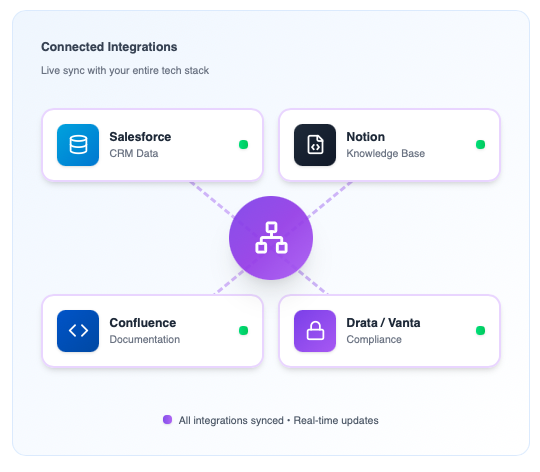
Live connections to your docs -- Connect Confluence, SharePoint, Google Drive, Notion, and documentation sites without relying on manual uploads.
Search across everything at once -- One query pulls from all sources. Find the SOC 2 report in SharePoint and the API spec in Confluence simultaneously.
Always current, never stale — Version-aware responses that reference the latest product specs, not last quarter's architecture.


You Shouldn't Need to Be the Expert on Everything to Sound Like One.
Sales engineers are expected to answer questions across security, infrastructure, compliance, and integrations, often for products they didn't build. The pressure isn't just getting the answer right. It's getting it right fast, with proof, while five other questionnaires are waiting.
Context matters — Iris treats "How does SSO work?" and "Which SSO protocols do we support?" as similar product question, and answers them using your source documentation and previous responses.
Source citations on every answer — Click any response to see the exact doc, page, and section Iris referenced. No black box. Your SMEs can verify in seconds instead of rewriting from scratch.
First draft ready in minutes — Upload an RFP, get a complete technical response drafted using your approved content. Review and refine instead of writing from scratch.

One Wrong Answer Can Derail a Deal. You Shouldn't Have to Worry About That.
Sales Engineers are the last line of defense before a technical claim goes out the door. If a response overstates your SOC 2 scope, misquotes an API limit, or lists an integration you don't actually support, it doesn't just look bad. It stalls the deal or kills it. The problem isn't carelessness. It's that nobody has time to manually verify 47 questions against source docs before the deadline.
Iris Verify shows exactly which documentation supports each claim so your team can review with confidence, not anxiety.
Linked to source documentation — Every technical claim, security control, and integration links to the spec sheet, cert, or guide that validates it.
Low-confidence flagging — When Iris doesn't have enough information to answer, it tells you rather than making something up.
Review trail for technical claims — Teams can see what was claimed and which documentation supported it.

Your Expertise Should Go to the Hard Problems, Not Routine Questions.
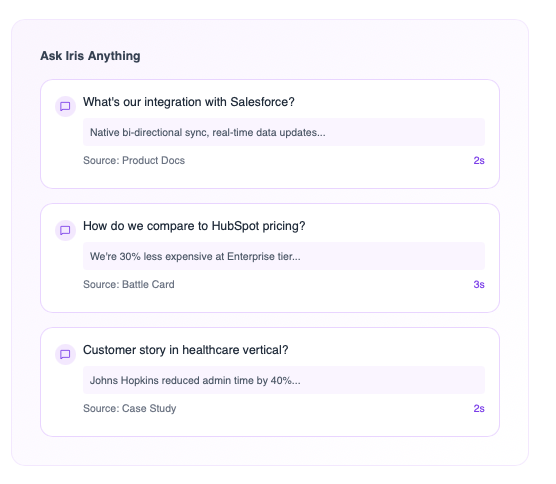
Every SE knows the feeling. You're deep in an architecture review or prepping for a technical evaluation and another AE pings you: "What does our Salesforce integration do?" or "Do we support SAML?" These aren't hard questions. They're just questions nobody else knows where to find the answer to. Multiply that across a full sales team and your strategic work gets buried under routine interruptions.
Self-service technical answers — AEs can find product capabilities, integration details, and security information without interrupting an SE.
Consistent messaging — Every AE uses the same approved technical content—no more conflicting product claims across the sales team.
SE escalation only when needed — Iris handles routine technical questions so SEs can stay focused on architecture reviews, complex evaluations, and high-value deal work.





_EasiestToDoBusinessWith_EaseOfDoingBusinessWith.svg)
_HighPerformer_HighPerformer.svg)




_BestSupport_QualityOfSupport.svg)


